
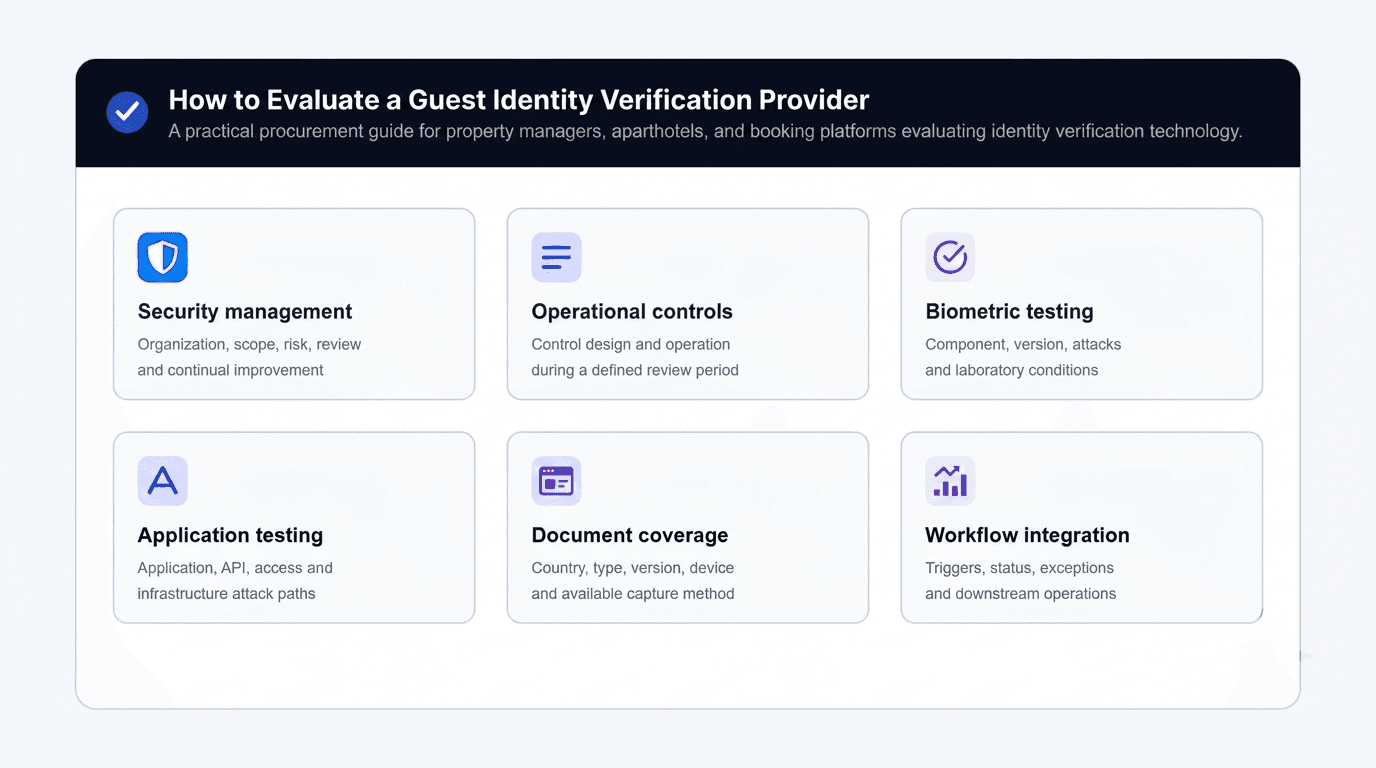
Choosing an identity verification provider is not simply a matter of comparing document counts or asking which company uses artificial intelligence.
A hospitality operator is selecting a system that may sit between a reservation, a guest's identity evidence, the property management system, digital access, and local reporting obligations.
That system must work for the guest, the operations team, the technical team, and the people responsible for privacy and compliance.
A strong evaluation therefore needs to cover more than document recognition.
It should examine what the provider verifies, how the technology is tested, how identity information is protected, what information the operator receives, what remains the operator's responsibility, how the system fits into the booking workflow, how exceptions are handled, and whether the product supports the operator's real markets.
Start with the workflow, not the feature list
Before comparing providers, map the current guest identity process.
Ask:
- When is the guest asked to verify?
- Which guests must complete the process?
- What evidence is required?
- Who reviews the result?
- What happens when verification fails?
- Does verification block check-in or digital access?
- Where must structured information be sent?
- How long must the evidence be retained?
- Which staff members need access?
A provider may offer strong document checks but still create more work if employees must manually create every session, copy every result, and chase every incomplete case. The product must improve the full operational process.
For smaller operators, this may mean a hosted portal that requires no integration. For larger operators, it may mean automatically creating a verification session when a reservation is confirmed, returning the result to the PMS, and allowing the next check-in action to continue.
Understand what is actually being verified
Identity verification can refer to several different checks.
A workflow may include:
- Document capture
- Document quality assessment
- Expiry checking
- MRZ parsing
- NFC data reading
- Template comparison
- Field consistency
- Facial similarity
- Liveness detection
- Authoritative-source checking
- Manual review
No single check should be treated as universally conclusive.
DocinVault's configured workflows can combine document quality, expiry, field consistency, MRZ, NFC, security signals, facial similarity, liveness, and manual review according to the customer's selected workflow.
Buyers should ask which controls apply to their configuration rather than assuming every available check runs in every session.
Ask for evidence that matches the risk
Different security evidence answers different questions. Buyers should ask for the material that addresses the product, workflow, and data in scope.
Public security overview
A public trust page should explain what data the service protects, where it runs, which parties process it, and how customers can ask security questions.
The description should separate current controls from planned work and avoid treating infrastructure-provider programs as product assurance.
Independent application and API review
A scoped review can evaluate authentication, authorization, session handling, APIs, webhooks, evidence access, tenant isolation, and common application weaknesses.
Buyers should ask who performed the work, what was in scope, when it was tested, whether manual testing was included, and whether significant findings were retested.
Privacy governance review
A privacy review should map processing purposes, roles, lawful bases, notices, retention, data-subject requests, subprocessors, and international transfers.
For a Georgian provider serving European customers, the review should consider Georgian law and European requirements where they apply.
Operational evidence
Access records, retention settings, incident procedures, subprocessor details, and data-flow documentation help a buyer understand how written controls operate in practice.
This evidence should be current, scoped, and available through an appropriate review process rather than reduced to a logo.
A provider that explains its current evidence and its limits is more credible than one that places every security idea under a generic trust heading.
Review the scope behind every security claim
For each security statement or report, request:
- The exact organization, product, or component assessed
- The product or component version
- The assessment period
- The assessor, reviewer, or responsible owner
- The systems and services included
- The systems and services excluded
- The review date and update cycle
- Retest or remediation status
- The conditions under which the claim applies
A useful claim identifies the product, version, scope, period, and evidence that support it. If those details are unavailable, the claim should not drive a procurement decision.
This is particularly important for third-party components and customer integrations. Evidence for one component does not automatically describe the wider application or the customer's deployment.
Examine data access, output, and retention
A hospitality operator does not always need unrestricted access to a passport image.
In many workflows, the team needs:
- Verification status
- Verified name
- Date of birth
- Document type
- Issuing country
- Expiry status
- Relevant reason codes
- A review status
- An audit event
Ask the provider:
- Is the raw document included by default?
- Can output be limited to selected fields?
- Can access be restricted by role?
- Are document views and downloads recorded?
- Can retention be configured?
- What happens when the retention period expires?
- How are biometric templates treated?
- Which technical logs remain after evidence deletion?
DocinVault is designed to return minimum structured output by default. Raw evidence access must be separately justified, controlled, and logged where it is enabled.
Its practice statement also states that the transient biometric vector used for facial comparison is deleted after the similarity level is established.
Confirm document coverage for real guest markets
A global coverage number is not enough.
Buyers should check:
- Issuing country
- Document type
- Document generation or version
- Capture method
- NFC availability
- Device compatibility
- Required image quality
- Supported security checks
- Local acceptance requirements
Document formats change over time. A country may issue several passport, identity card, residence permit, and driving licence versions at once.
DocinVault's coverage catalog is extensive but not exhaustive. It asks customers to confirm the documents enabled for their specific market, workflow, capture method, and risk policy.
Test exception handling
Most product demonstrations show a clear document and a successful result. Real operations include:
- Blur
- Reflections
- Cropped documents
- Expired documents
- Damaged documents
- Poor mobile cameras
- Name differences
- Missing document sides
- Low-confidence facial comparisons
- Failed liveness checks
- Unsupported documents
- Guests who cannot complete the default flow
Ask:
- How many retries are allowed?
- What guidance does the guest receive?
- Can a case be routed to manual review?
- Who can review it?
- Is the decision history preserved?
- Can the operator create an alternative process?
- How are false rejection complaints handled?
DocinVault supports configured retry rules, automated statuses, and manual-review routing. The customer determines how the result affects its own process.
Understand the division of responsibility
The provider does not determine every legal and operational requirement for the customer.
The hospitality operator normally remains responsible for defining:
- The purpose of verification
- The lawful basis
- Required identity attributes
- Accepted evidence
- Authorized users
- Retention period
- Reporting requirements
- Manual-review rules
- The consequence of each verification status
DocinVault configures workflows market by market and does not claim that one configuration satisfies every jurisdiction.
A responsible vendor should help customers configure the technology without claiming to replace the customer's legal or operational judgment.
The final decision should be evidence-based
The best identity verification provider is not necessarily the one with the longest feature list.
It is the provider that can show:
- A workflow that fits daily operations
- Clear assurance boundaries
- Appropriate technical testing
- Controlled data handling
- Market-specific document support
- Strong exception management
- Transparent customer responsibilities
- Measurable reduction in manual work
Hospitality identity verification should not add another isolated tool. It should become a controlled part of the reservation and check-in workflow.
Frequently asked questions
Questions to use when comparing identity verification providers and reviewing supporting evidence.
Continue the conversation
Evaluate DocinVault against your current workflow
Tell us how your team currently collects, reviews, stores, and transfers guest identity information. We will help you map the process and identify what can be controlled or automated.
contact@docinvault.com