
Transaction Monitoring
Monitor configured activity for unusual patterns.
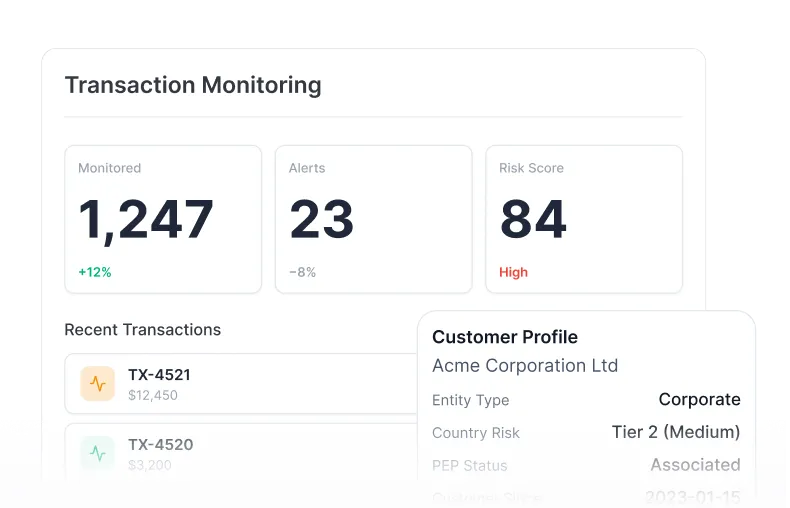
Evaluate transaction activity against configured rules, risk indicators, and review paths while keeping each alert connected to customer context.
- Part of a guest compliance session
- Hosted, API, and webhooks
- Configured human review
How it works
How KYT monitoring works
Evaluate booking-linked activity, route relevant alerts, document the decision, and continue monitoring.
Receive transaction data
Configured booking, payment, payout, or refund events enter the workflow with relevant customer context.

Evaluate rules and indicators
The monitoring logic applies the customer's thresholds, patterns, and risk conditions.

Create and route alerts
Events that meet the configured criteria become cases for an authorized reviewer or downstream process.

Investigate and document
Authorized reviewers examine the connected guest, booking, and transaction context and record the outcome.

Continue monitoring
The workflow continues or adjusts monitoring according to the approved decision and customer rules.

Transaction monitoring
Move from isolated alerts to a controlled investigation workflow
KYT monitoring connects transaction signals with customer identity, risk, and review context so authorized teams can investigate and document the resulting decision.
Configurable rules
Define the transaction patterns, thresholds, customer segments, and risk conditions relevant to the operating model.
Prioritized alerts
Route configured events into queues with the customer and transaction context required for triage.
Review history
Record investigator actions, evidence, dispositions, and follow-up tasks in the case workflow.
Agentic control plane
Automation operates inside defined authority.
The control plane defines what may happen, the execution plane records what happened for this booking, and the evidence plane preserves the resulting audit record.
Control plane
What agents may do
Workflow profiles, schemas, thresholds, permissions, and human-review gates define agent authority.
- Govern
- Map
- Measure
- Manage
Execution plane
What happened for this booking
Configured agents request data, guide retries, run checks, route exceptions, and trigger approved next actions.
- Actions
- States
- Reason codes
- Review gates
Evidence plane
What can be reviewed later
Booking linkage, timestamps, decision history, integrity references, and export manifests form the audit record.
- Audit events
- Hashes
- Retention
- Export manifest
Agents resolve routine gaps within fixed schemas and configured policies. They do not overwrite core identity data or approve policy exceptions without an authorized human decision.
Capabilities
Transaction monitoring with customer context
Configure the rules and review model rather than forcing every organization into one policy.
Discuss your workflow- 01Rule and threshold configuration
- 02Customer risk context
- 03Alert prioritization
- 04Case assignment
- 05Investigation history
- 06Ongoing monitoring
Use cases
Where KYT monitoring fits
- Booking payment review
- Host and property payouts
- Refund and chargeback review
- Marketplace transaction activity
- High-risk booking patterns
- Investigation and dispute evidence
Security and privacy
Controlled by design, documented in public.
Every module uses the same access, output, audit, and retention boundaries as the wider guest compliance workflow.
Minimum necessary output
Operators receive the approved status and fields rather than unrestricted document copies by default.
Booking-linked history
Configured consent, status, access, and review events remain tied to the relevant session.
Controlled retention
Access and retention rules are configured for the customer's workflow and applicable obligations.
FAQ
Frequently asked questions
Key implementation and workflow questions for transaction monitoring.
Configure your flow
See Transaction Monitoring inside a DocinVault workflow
We will map the module to your customer journey, operating market, and review requirements.